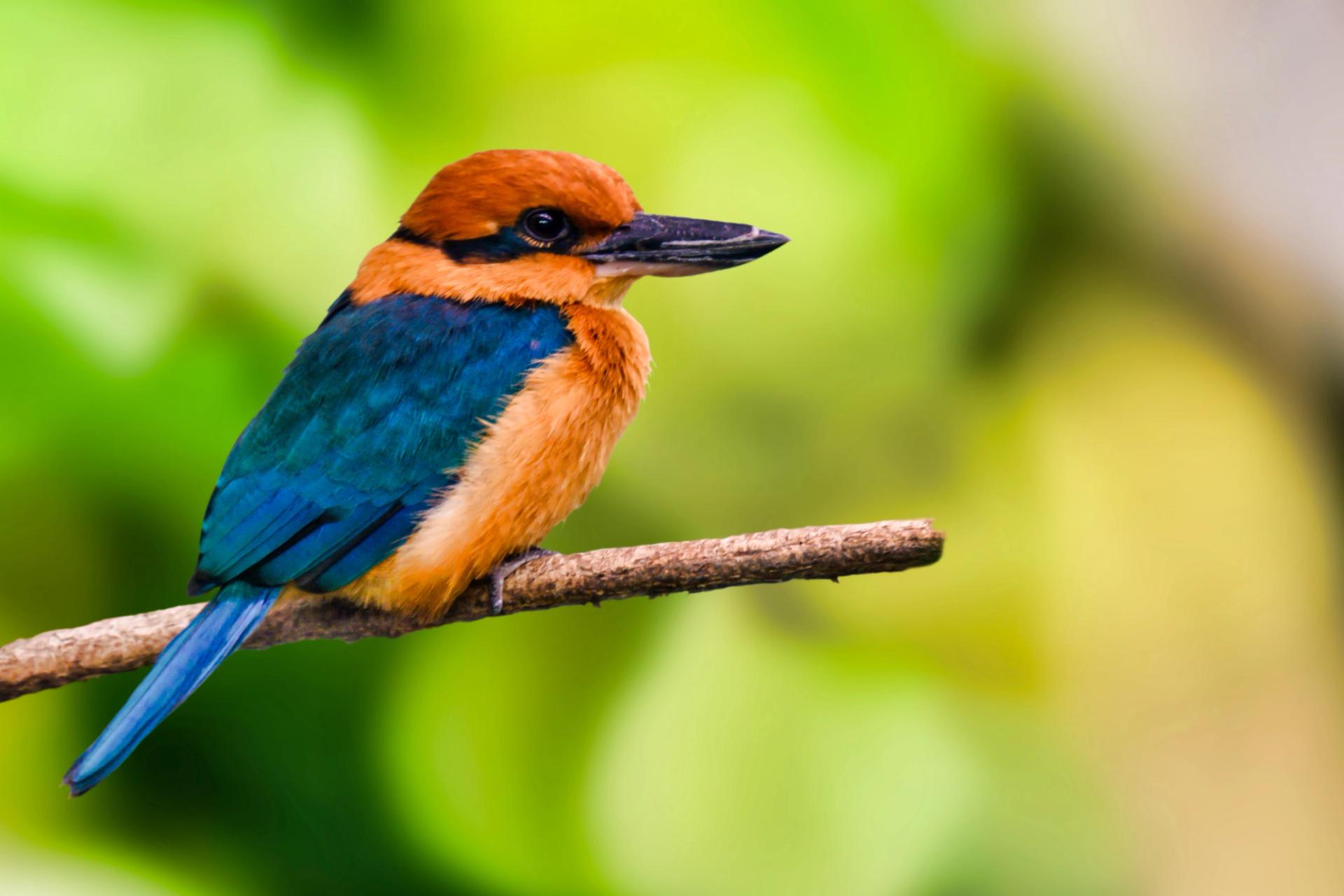
Guam kingfishers, called sihek in Chamorro, are very rare little birds — there are fewer than 150 left in the world. The males have iridescent plumage, their wings change from blue to green as they move, and their bellies are a soft cinnamon brown. They use their long beaks to dig nesting cavities in rotting trees, and their call is said to be so regular that it was once used to tell time.
The National Aviary plays a crucial role in rehabilitating sihek populations, with the hope of returning more of them to their native island homes.
🇬🇺 Kingfishers and the Brown Tree Snake
Songbirds fill the stories of the Chamorro people of the Mariana Islands and Guam. In one story, a woman dressed in blue and orange is transformed into the first sihek, whose song was so loud it could lure people to get lost in the forest.
After World War II, an invasive species of snake was introduced to the island of Guam by way of cargo ships and military transports. The tree snake preyed heavily on kingfishers, and coupled with habitat loss, the population shrunk to a few dozen birds by the late 1980s.
🦜 The Growing Sihek Population
Biologists rescued the last of the wild kingfishers, and in captivity, their numbers have steadily increased thanks to the dedicated work of aviculturists, genetic testing, and careful incubation. At least three chicks hatched at the National Aviary were recently released from their homes on Palmyra Atoll. The aviary also piloted special temporary radio transmitter technology to help scientists track their success over the following weeks.
Though still considered extinct in the wild, the species could soon be upgraded to critically endangered thanks to work being done right here in Pittsburgh. Learn more about these special birds at the aviary’s museum-style Canary’s Call exhibit.
🦉Need more Aviary activities? Check out these upcoming events, all included with admission.
- Oct. 12: International African Penguin Awareness Day | 10:30 a.m. - 4 p.m.
- Oct. 17: Brushes & Birds: Evening Edition | 5:30-8 p.m.
- Oct. 19, 20, 26, 27: Owl-O-Ween | 11 a.m. – 3 p.m.