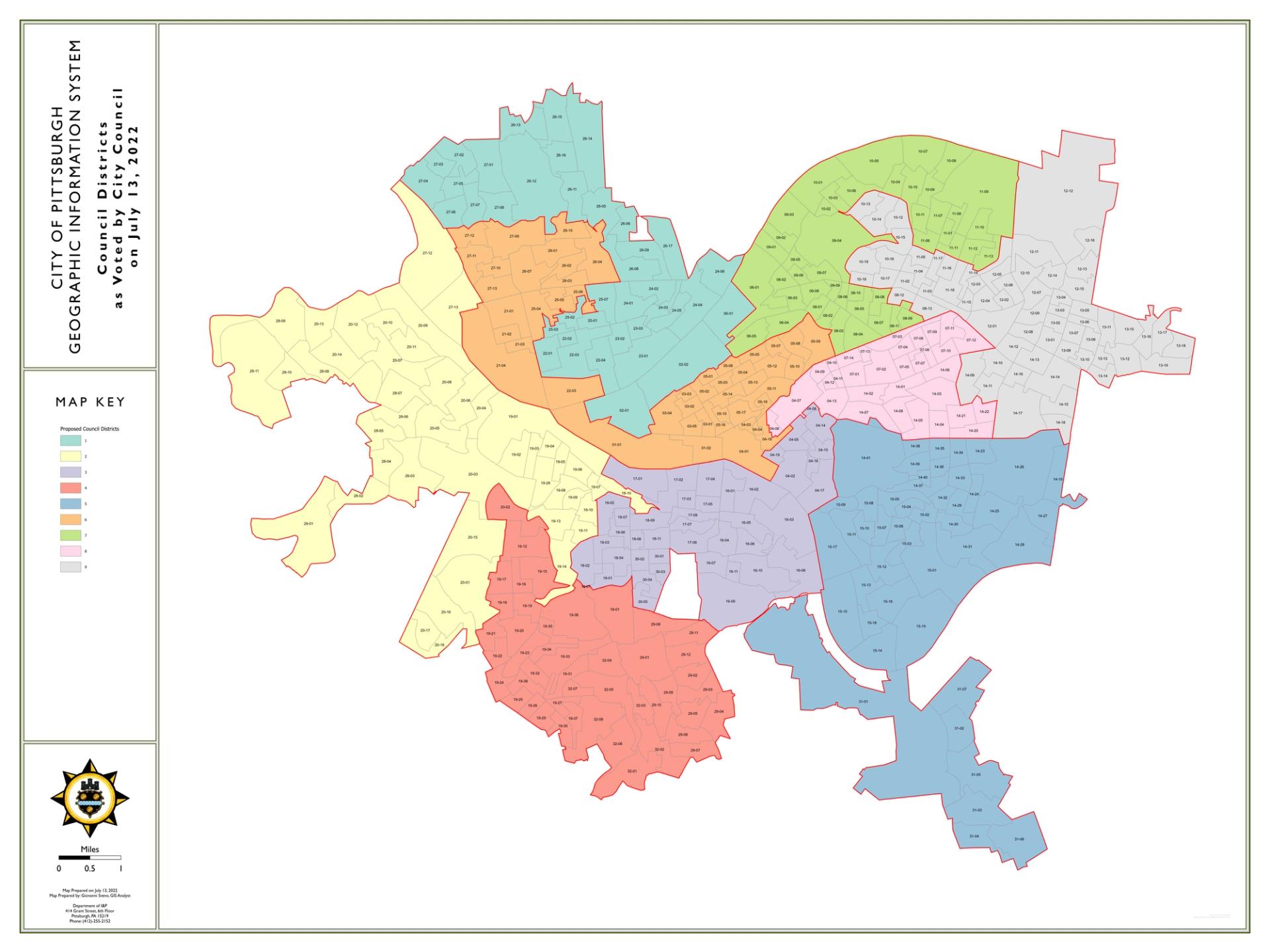
Pittsburgh City Council is composed of nine representatives from districts across the city. A new map is drawn every 10 years based on the most recent census. Currently, each councilor represents about 34,000 Pittsburghers, and collectively they’re responsible for passing a balanced budget and adopting policies such as banning traffic stops for minor violations and decriminalizing possession of marijuana.
The councilors are elected to four-year terms and must live within the district they represent. That wasn’t always the case. Pittsburgh’s home rule charter stated that Council would be elected at large, and that was the case for nearly two centuries. The charter did give Council the authority to change the election process, and it did change in 1987 when voters approved a ballot question to switch to council districts which were originally drawn by the Court of Common Pleas.
So, why the change? The debate was driven by residents seeking more balanced representation. From 1911-1987, only six Black Pittsburghers won election to Council. Some Republicans also supported the change because no GOP candidate had been elected since the 1930s. Plus, Councilors are supposed to act on behalf of the entire city, but in the 80s as many as seven or eight of the nine lived in the East End causing other neighborhoods to question if they were getting a fair shake.
Did the change work? Former Pittsburgh School Board president Jake Milliones became the first Black resident elected by district to Council that year. Currently, Black residents comprise 23% of the city’s population and hold two of the nine seats. For the GOP—not so much. The streak of not winning a Council election has stretched to nine decades.
Want to get involved? Council meets every Tuesday and Wednesday in addition to public hearings. Or you can contact them here.